
• Skip to primary navigation
  • Skip to main content
  • Skip to primary sidebar
  • Skip to footer
Implant Evolution

Implant Evolution

Connecting Patients with Implant Dentists

For Dentists
  • Learn About Dental Implants
    • Dental Implant Costs
    • Dental Implant Procedures
    • Dental Implant FAQ
  • Journal
  • Blog
Home › Problems & Preventions › How long does it take for dental implants to heal?

How long does it take for dental implants to heal?

March 14, 2023 by Aaron Pryor

The healing time for dental implants varies from person to person. In terms of recovering from the implant procedure, you can typically return to work the next day. With simple implant procedures, patients can sometimes return to work the same day.

For many implant procedures, post-procedure pain can typically be controlled using over-the-counter medications and usually diminishes gradually over the course of a few days.
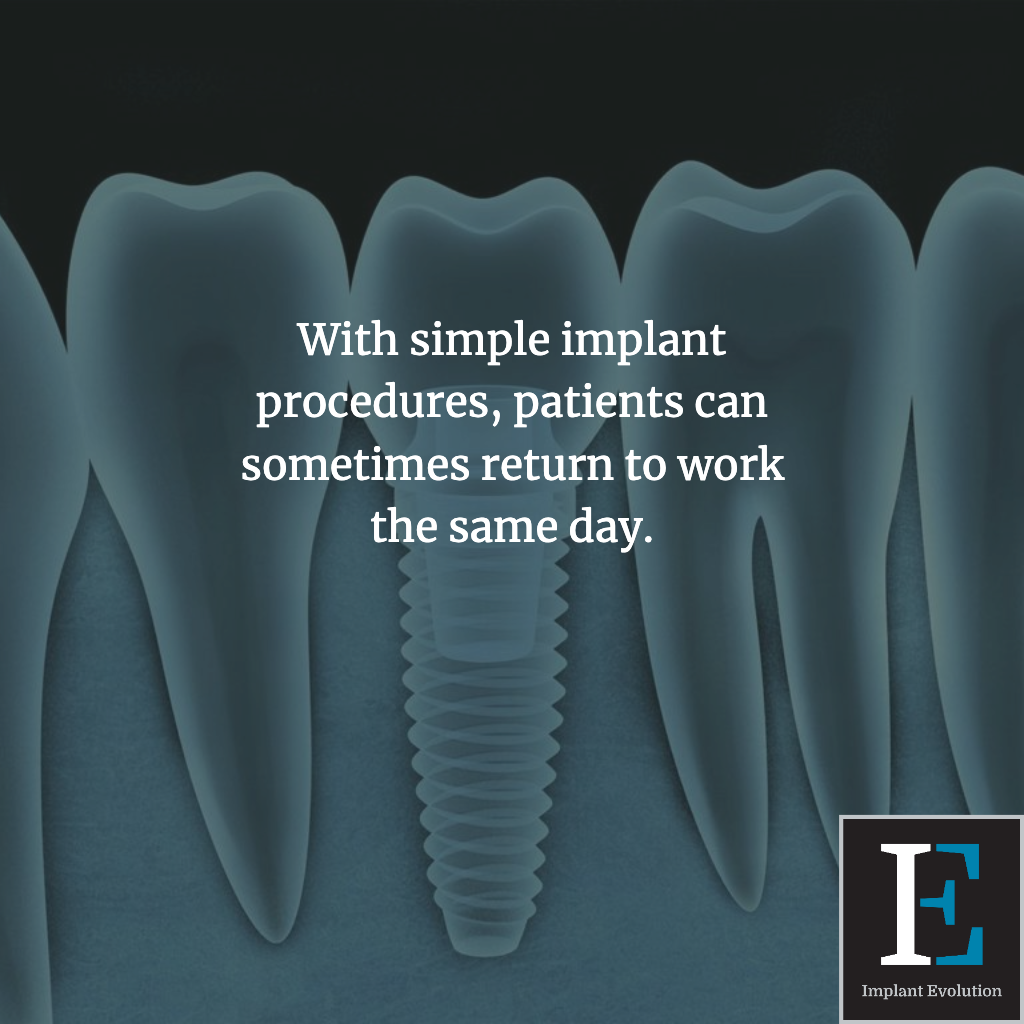
Typically it takes three to four months before an implant is ready to support an abutment and crown. At that point your implant dentist will place the abutment or “post” onto the implant, and then the crown is either cemented or screwed onto the implant. Two short appointments are all that is needed for the final restoration.

Recovery time can also be affected by the number of implants you receive, how carefully you follow post-operative instructions, and whether you have any medical conditions that may slow your healing time. Certain habits or behaviors, like smoking, can also adversely affect healing time and jeopardize the success of your implant procedure.

How do they do dental implants in one day?

Typically dental implants are performed in a multi-step process, but in some cases, a tooth can be extracted and an implant inserted, all within an hour or two. You may be a good candidate for a same-day implant if you have healthy oral tissue, have adequate bone density in the implant area and don’t exhibit any medical conditions or behaviors, like smoking, that might slow the healing process.

Same-day or immediate implant placements have a slightly higher failure rate than the conventional implant process, but immediate implant surgeries are becoming more common and success rates have been steadily increasing, especially when coupled with bone grafting procedures.

Filed Under: Problems & Preventions

Primary Sidebar

Have A Question?

Get answers for your implant questions

Categories
  • Implant Basics
  • Problems & Preventions
Recent Patient Knowledge Posts
  • Are there cheap dental implants?
  • How long does it take for dental implants to heal?
  • Why are dental implants so expensive?
  • 5 Things To Look For In An Implant Dentist
  • What Are Dental Implants Made Of?
  • How do you know if your body is rejecting a dental implant?
  • Can you replace all your teeth with dental implants?
  • Which is better: a bridge or dental implant?
  • How long does it take for dental implants?
  • What do I do if my dental implant falls out?

Footer

Implant Evolution
4251 Lebanon Pike
Hermitage, TN 37076
For Patients
  • Learn About Dental Implants
  • Ask a Question
  • Patient Knowledge Base
For Dentists
  • Implant Evolution Journal
  • Journal Submission Policy
  • Submit a Listing
  • Dentist Login
  • Manage Listings
  • Log Out
General Info
  • About
  • Contact
  • Privacy Policy
  • Terms & Conditions
  • Web Credits
  • Use of Cookies
  • Accessibility

This site contains information intended for dental profesionals. Advertisements on this site do not constitute a guarantee or endorsement by the publisher of the quality or value of services advertised.

Copyright © 2026. Implant Evolution. All Rights Reserved.

Manage Consent
To provide the best experiences, we use technologies like cookies to store and/or access device information. Consenting to these technologies will allow us to process data such as browsing behavior or unique IDs on this site. Not consenting or withdrawing consent, may adversely affect certain features and functions.
Functional Always active
The technical storage or access is strictly necessary for the legitimate purpose of enabling the use of a specific service explicitly requested by the subscriber or user, or for the sole purpose of carrying out the transmission of a communication over an electronic communications network.
Preferences
The technical storage or access is necessary for the legitimate purpose of storing preferences that are not requested by the subscriber or user.
Statistics
The technical storage or access that is used exclusively for statistical purposes. The technical storage or access that is used exclusively for anonymous statistical purposes. Without a subpoena, voluntary compliance on the part of your Internet Service Provider, or additional records from a third party, information stored or retrieved for this purpose alone cannot usually be used to identify you.
Marketing
The technical storage or access is required to create user profiles to send advertising, or to track the user on a website or across several websites for similar marketing purposes.
  • Manage options
  • Manage services
  • Manage {vendor_count} vendors
  • Read more about these purposes
View preferences
  • {title}
  • {title}
  • {title}